

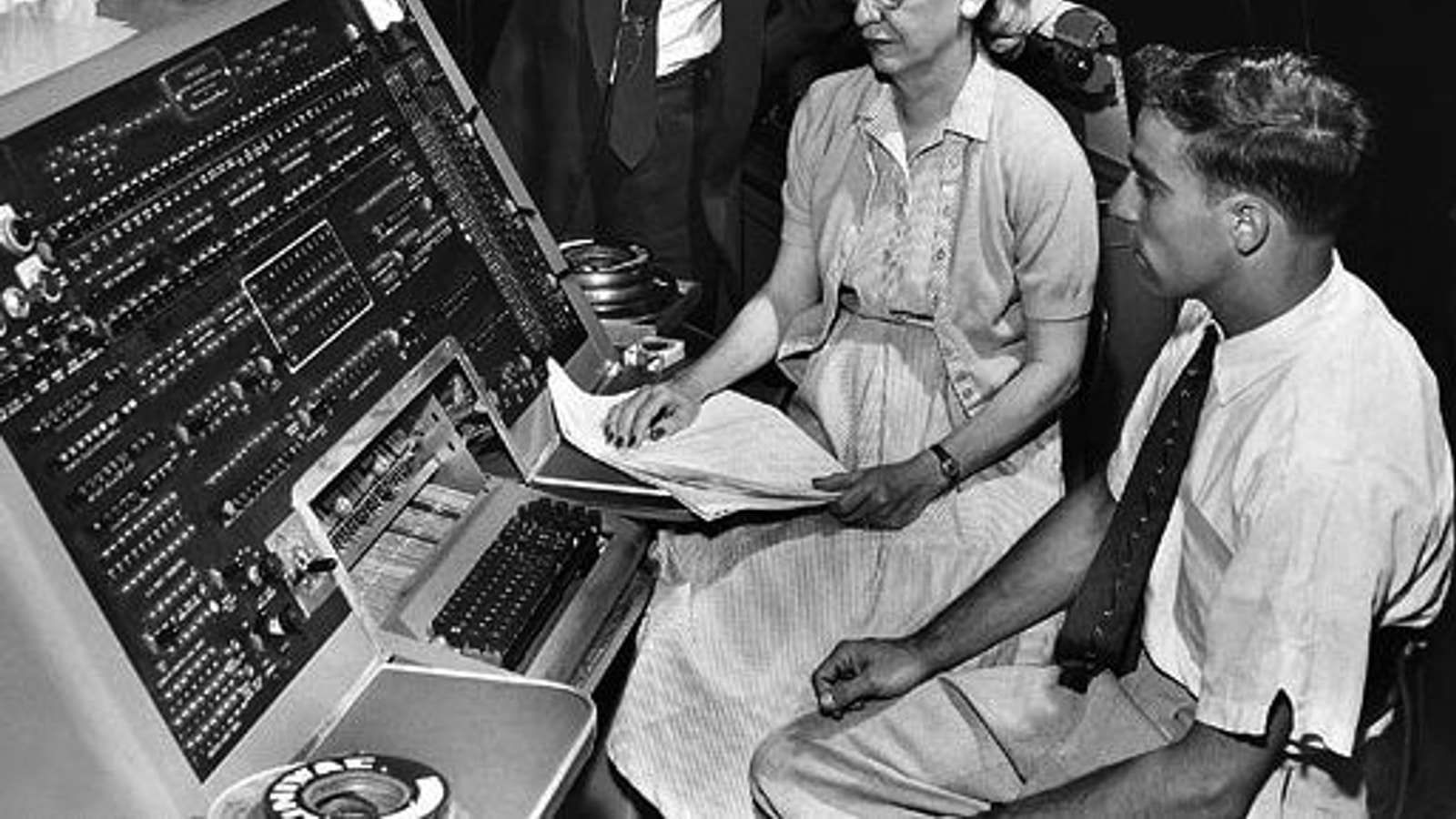
COBOL has been dead for most of its life. It died when minicomputers arrived, died when personal computers arrived, died when client-server architecture arrived, died when the web arrived, died when Java arrived, died when cloud computing arrived and is currently being killed by artificial intelligence. Each funeral generates articles, migration contracts and jokes about elderly programmers being summoned from retirement. Then payroll runs. Claims settle. Taxes process. Accounts reconcile. The corpse reports for another shift.
The joke survives because the software industry confuses novelty with existence. A language becomes invisible when new developers stop selecting it for greenfield projects. That is not the same as becoming irrelevant. COBOL occupies the least glamorous layer of computing: mature transaction systems whose continued operation is assumed until failure makes them front-page news.
A language is not dead while its failure can stop money, benefits, insurance, logistics or public administration. COBOL is not fashionable. It is load-bearing.
The language solved a real institutional problem.
COBOL—Common Business-Oriented Language—emerged from late-1950s efforts to make business data processing portable and understandable across machines. Grace Hopper's compiler work helped establish the proposition that programmers could express operations in a language closer to ordinary business vocabulary than machine instructions. COBOL programs described records, files, decimal arithmetic and procedural rules in a form suited to organizations processing large volumes of structured transactions.
That design is routinely mocked as verbose. Verbosity was part of the point. The code was expected to represent business rules that accountants, analysts, government departments and future maintainers might need to inspect. A record layout was not merely a computer structure; it encoded the institution's definition of an account, employee, payment, claim or taxpayer. The program sat between law, policy and machinery.
Once those definitions entered production, they accumulated gravity. New channels and applications were built around them. Databases, batch schedules, message queues and reporting tools assumed their outputs. Exceptions became routines. Regulatory changes became patches. Mergers added translation layers. A program written decades ago could remain near the center while generations of newer software formed rings around it.
Age is not the same as failure.
Old systems attract two lazy conclusions. The first is that age proves reliability: the machine has operated for forty years, therefore it is safe. The second is that age proves uselessness: the software is old, therefore replacement will be easy. Both are wrong.
Survival does provide evidence. A production system that has processed millions or billions of transactions has encountered cases that a replacement has not. Its ugly branches may encode court decisions, union rules, accounting exceptions, disaster procedures and scars from failures nobody documented elsewhere. Deleting the code can delete institutional memory.
But survival can also conceal fragility. Hardware ages. Vendor support ends. Interfaces become difficult to secure. Knowledge concentrates in a shrinking group. Recovery procedures assume people or equipment that no longer exist. A stable core can be surrounded by brittle dependencies. “It still runs” answers only one question.
The U.S. Government Accountability Office has repeatedly documented this tension. Its 2016 review identified federal investments using decades-old technology, including COBOL and assembly language. In 2019 it identified critical systems supporting essential government missions whose modernization plans were incomplete. A 2025 review found eleven federal legacy systems most in need of modernization; eight used outdated languages and seven operated with known cybersecurity vulnerabilities. The systems supported functions including health care, tax processing, critical infrastructure and national security.
Those findings do not prove that COBOL itself creates the vulnerability. A maintained COBOL application on supported hardware can be safer than a rushed web replacement. The risk arises from the system around the language: unsupported components, weak identity controls, undocumented integrations, scarce expertise and modernization programs that cannot accurately reproduce the existing behavior.
The code is only half the system.
Organizations often imagine migration as translation. Convert COBOL statements into Java, C# or another supported language, move the data, run tests and shut off the mainframe. That model treats syntax as the problem. In mature transaction systems, syntax may be the easiest part.
The real system includes job-control scripts, schedulers, file-transfer conventions, terminal workflows, reconciliation reports, manual exception handling, overnight batch windows, external partners and human operators who know that a particular warning can be ignored only on the third Tuesday. Some rules exist in code. Others live in runbooks. Others exist only because an experienced operator recognizes a pattern and intervenes.
Modernization fails when it reproduces the obvious path but not the accumulated edge cases. A new service passes demonstration tests, then encounters an account created under a law repealed twenty years ago, a negative balance represented through an old convention, or a partner file whose malformed field has been tolerated since 1987. The legacy system contains behavior nobody intentionally designed but somebody now depends upon.
This is why automated translation is useful without being magical. AI-assisted tools can explain code, identify dependencies, generate tests and convert sections into newer languages. They cannot independently decide which accidental behaviors constitute binding business requirements. Translation can preserve a bug that should disappear or erase a quirk that functions as policy. The hard problem is not producing modern syntax. It is establishing what the old system actually promises.
The disappearing workforce story is incomplete.
COBOL coverage often frames the knowledge problem as demographics: veteran programmers retire, young developers avoid the language, and institutions compete for a dwindling pool. That is real, but it understates the issue. A programmer can learn COBOL. The scarce resource is system-specific understanding.
Someone who knows the language does not automatically know why one agency's batch sequence cannot move, which downstream bank expects a certain filler field, or how a particular insurer reconstructs a interrupted run. Those facts emerge from code, documents, logs and people. Losing the person who knows the reason for a strange routine is different from losing someone who knows the syntax.
The remedy is therefore not merely to teach more COBOL, though that remains sensible. Institutions must capture architecture, data lineage, operating procedures, failure history and business meaning. Pair experienced maintainers with newer engineers. Record explanations while systems are healthy. Build test corpora from real edge cases. Treat reverse engineering as preservation work rather than an embarrassment.
There is also a cultural barrier. Young programmers are told that legacy work is career suicide, while organizations advertise roles as maintenance drudgery. Then executives complain that nobody wants to learn the system. If the software supports civilization-scale functions, maintaining and transforming it is not lesser engineering. It is infrastructure engineering, and compensation, authority and training should reflect that fact.
Modernization needs a strangler, not a guillotine.
The safest replacement strategy is usually incremental. Map the system. Observe production behavior. Establish interfaces around bounded capabilities. Move one function at a time while comparing old and new outputs. Preserve rollback. Retire components only after downstream dependence has been demonstrated—not assumed—to be gone.
This approach is slower than announcing a total replacement and faster than recovering from one. It allows the organization to separate three questions: which functions remain valuable, which implementation risks must be removed, and which historical behaviors should not survive. It also prevents the legacy system from becoming a single all-or-nothing migration event.
Cybersecurity must remain explicit. Network segmentation, strong identity, monitored service accounts, supported gateways and immutable logs can reduce exposure while modernization proceeds. A legacy core should not be placed directly on modern networks simply because a new interface needs access. Every bridge between eras becomes a security boundary.
The dusty book still matters.
For generations of programmers, the first encounter with COBOL was not a university curriculum or corporate initiative. It was a forgotten manual on a shelf, an old machine in a lab, or a parent who knew where the institution stored its documentation. The language looked ancient because it was ancient. It also revealed a different philosophy of computing: data had shapes, records had meaning, jobs had schedules and software existed to make an organization behave consistently.
That knowledge remains useful even when no COBOL statement is written. Contemporary systems still process records, enforce business rules, reconcile state and fail at boundaries. The cloud did not eliminate batch processing; it rented batch processing by the minute. Microservices did not eliminate dependency chains; they made them harder to see. Event streams did not eliminate the need for accounting; they increased the number of events that must reconcile.
COBOL's longevity is therefore not only a story about institutional inertia. It is evidence that some computational problems remain stable while the surrounding fashion changes. Money still requires exact decimal arithmetic. Benefits still require eligibility rules. Transactions still require durable records. Auditors still require explanations.
Cyberdelia assessment
Calling COBOL dead prevents clear thinking. It encourages executives to underestimate the system, discourages engineers from learning it, and turns migration into a symbolic war against age. The useful distinction is not legacy versus modern. It is understood versus opaque, supported versus abandoned, contained versus exposed, and replaceable versus load-bearing.
Some COBOL systems should be retired urgently. Some should be wrapped and observed while replacements mature. Some will remain economically rational for years. None should depend on undocumented heroics from the final person who remembers why the batch job pauses at 2:13 a.m.
The language is not immortal. The dependency is.
Method and limitations
Cyberdelia reviewed GAO legacy-system findings, IBM material on mainframe and COBOL modernization, and historical material on Grace Hopper and business-language development. Public inventories describe selected government systems, not the complete worldwide COBOL estate. Claims that COBOL processes a specific percentage of all financial transactions vary widely and were excluded because no reproducible global denominator was identified.
Sources and further reading
- Critical legacy systems and modernization plans — U.S. Government Accountability Office, 2025
- Agencies Need to Develop Modernization Plans for Critical Legacy Systems — GAO, 2019
- Federal Agencies Need to Address Aging Legacy Systems — GAO, 2016
- Introduction to the New Mainframe: z/OS Basics — IBM Redbooks
- Grace Hopper and four eras of programming — White House archive
Corrections: Cyberdelia preserves material corrections and updates through the site's correction process.