
Brain organoids have always had a housing problem.
Researchers can grow small three-dimensional assemblies of human neural cells in a dish, but the dish is not a body. It does not provide normal vascular support, sensory input, motor output or the developmental environment that shapes a nervous system while it is being used.
Transplanting organoids into rodents partially solves that problem, but previous grafts had to compete with a host brain already taking up the space, building circuits and maturing on its own schedule.
A Stanford-led team has now changed the architecture instead of fighting the competition.
They made room first.
In a Nature study published September 16, Konstantin Kaganovsky, Kevin Kelley, Tilo Gschwind, Paul Harary and colleagues used a genetic strategy that depletes the glutamatergic neurons that would normally form much of the mouse neocortex and hippocampus. Human stem-cell-derived cortical organoids were then engrafted into that vacant developmental territory soon after birth.
The result is what the team calls a xenocortical mouse.
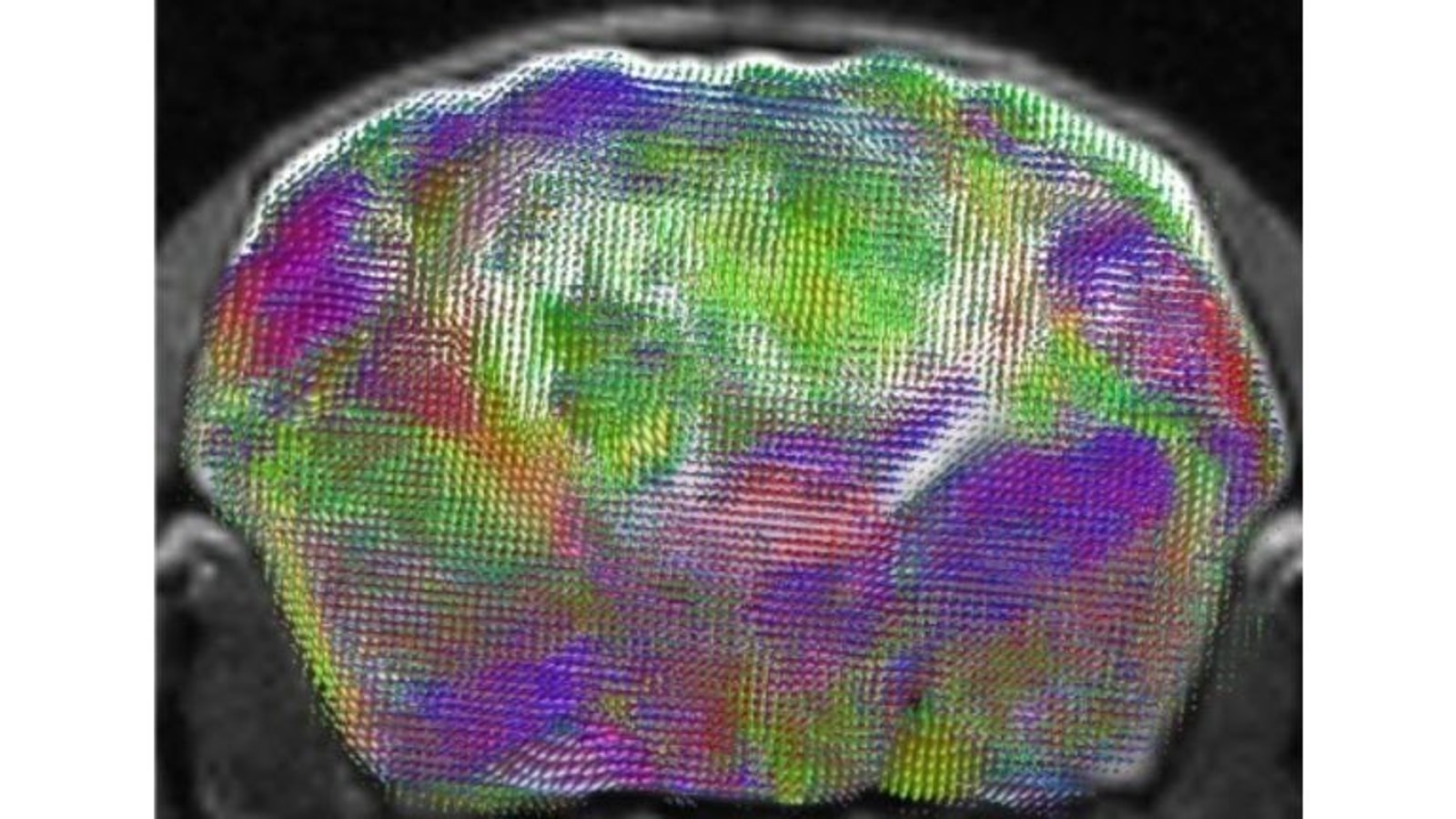
Without the normal rodent cortex occupying the same space, the human grafts expanded dramatically. Nature reports that the tissue could fill more than 90 percent of the available cavity and send projections deep into the host nervous system. The research article reports diverse human cortical cell types, broad calcium activity and electrophysiological patterns resembling developing circuits.
This is not a mouse with a human brain. It is a deliberately engineered animal model in which a substantial region normally occupied by mouse cortical tissue is instead occupied by developing human cortical organoid tissue.
The body changes what an organoid can become.
Organoids in dishes are useful precisely because they simplify biology. They also simplify away things researchers eventually need. A living host provides circulation, hormones, movement, sensory signals and a nervous system that the graft can connect to.
The new model produced cell types that had been difficult to generate in vitro. Nature highlights cells resembling von Economo neurons, a rare neuronal class associated with social cognition in humans and some other animals and implicated in frontotemporal dementia. Finding such cells in the graft does not mean the mouse acquired human social cognition. It means the developmental environment allowed the human tissue to move into cellular states that a dish had not reproduced.
That is exactly why the model matters.
Disease research gets a circuit-level readout.
The team exposed the animals to low oxygen to model injury to developing human cortical tissue. Because the human graft is wired into a living animal, researchers can measure not only cellular damage but downstream changes in movement and behavior.
That creates a bridge between two experimental worlds. Cell culture gives molecular access. Animal models give whole-organism readouts. Xenocortication puts human-derived neural tissue inside the second system without pretending the result is a normal human brain.
The potential applications include neurodevelopmental disorders, epilepsy, schizophrenia, cerebral palsy and neurodegenerative disease. More importantly, the platform offers a place to test whether a molecular intervention changes circuit function and behavior rather than merely changing a biomarker in a dish.
The ethical problem scales with the integration.
The reported behavioral data do not show some sudden leap into human-like intelligence. Nature notes that the grafts did not make the mice intellectually enhanced. The animals retained broadly preserved locomotion with selective differences in coordination and spontaneous behavior.
But the absence of a science-fiction outcome is not the end of the ethics discussion. The entire purpose of the model is deeper integration. Better integration makes the science more useful while also making the boundary more ethically consequential.
The relevant questions are empirical. How much human neural tissue is present? What cell types emerge? Where do their projections go? What kinds of sensory and motor loops do they enter? What behavioral capacities change? What welfare burdens does the host experience? Those questions are stronger than vague arguments about whether a mouse has become "part human."
The breakthrough is not the creation of a humanized super-mouse. It is the creation of enough developmental space for human cortical tissue to participate in a living nervous system at a scale previous grafts could not reach. That turns organoids from isolated models into components of an experimental body. The scientific opportunity is enormous, and the ethical obligation grows for exactly the same reason.
The boundary did not disappear. It became measurable.