

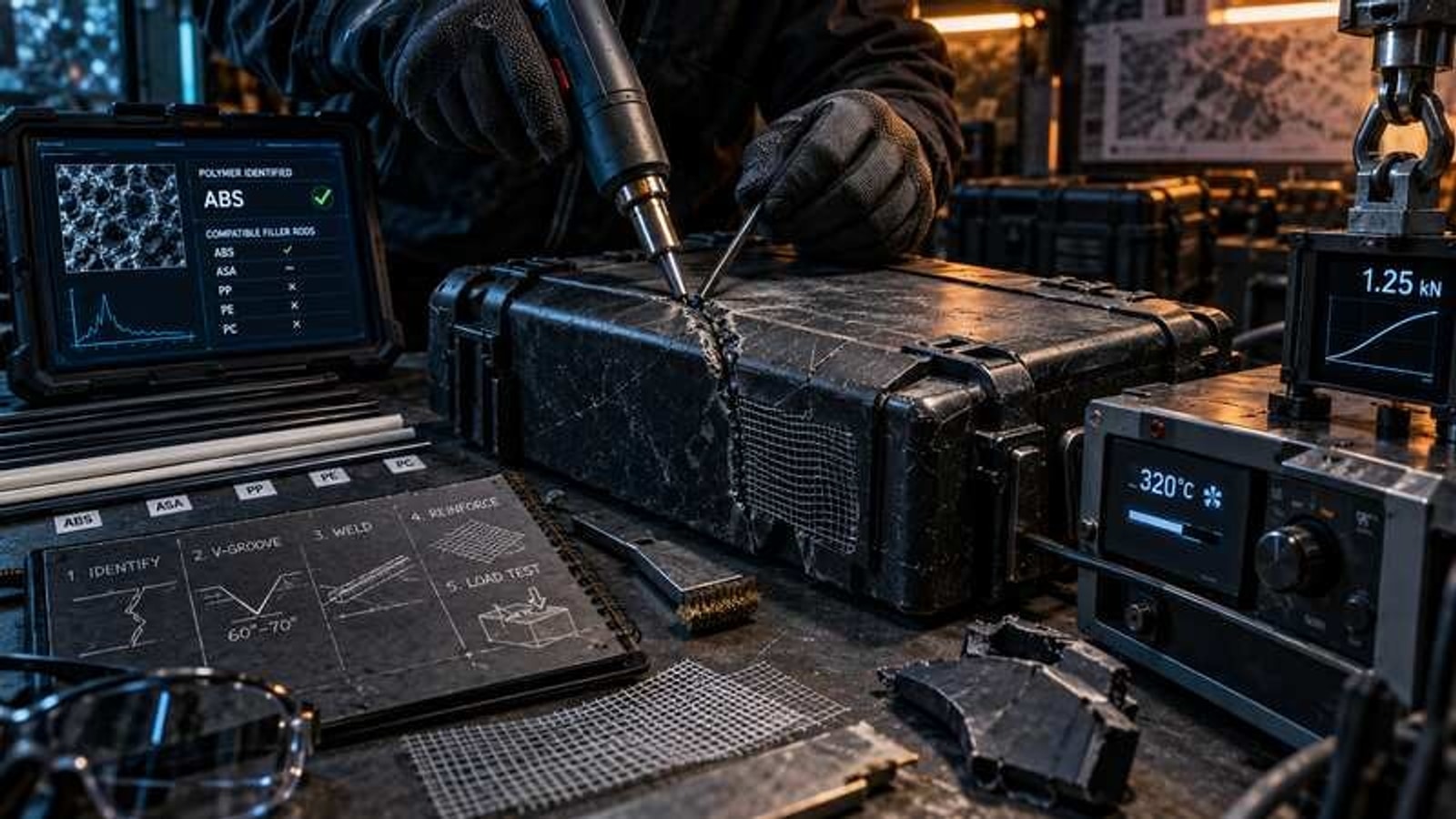
A screw head catches a thin plastic floor while the thing is being dragged. The damage is small enough to insult you and large enough to ruin the object. This is the kind of failure that sends people toward three bad options: tape, random glue, or turning a soldering iron into a tiny flamethrower.
There is a better sequence.
Stop the damage from growing.
Unload and dry the object. Clean both sides of the damaged region. If the tear terminates in a sharp point, that point is a stress concentrator. The repair needs to extend beyond it. On some thicker plastics, a carefully placed tiny stop-hole at the crack tip can reduce propagation; on thin flexible material, that may create more damage than it prevents. Geometry matters.
Match the polymer when possible.
Milk jugs are commonly high-density polyethylene. Many inexpensive molded tubs, toys and utility items are polyethylene or polypropylene. Those materials are notoriously indifferent to many household adhesives. A donor patch from known-compatible material can be more useful than an expensive glue that never truly wets or bonds to the surface.
The recycling mark is the first clue. Use it.
A patch carries load. A smear does not.
The patch should overlap sound material on every side of the tear and have rounded corners where practical. Sharp patch corners create their own peeling points. If access exists, reinforcing from the less visible side protects the working surface while putting more material across the damaged zone.
Heat is a process variable.
Plastic welding works by bringing compatible thermoplastic surfaces into a softened state and consolidating them together. That does not mean maximum temperature. Work gradually. Heat a small zone, press and blend, then move. A broad overheated region becomes thinner and weaker even if it looks smooth.
A soldering iron can perform crude field welding, but its tip temperature is often much higher than the plastic requires. Ventilation matters, and unknown plastics should not be casually burned. If the material chars, smokes heavily or discolors rapidly, the process has left “welding” and entered “decomposition.”
Test before trusting.
After cooling completely, flex the repair gently and inspect the perimeter. For a water-holding item, test with a shallow fill first and watch both sides of the repair. Increase load in stages. A dry-looking patch is not evidence until the object sees the stress it was repaired to survive.
Low-budget repair is not the opposite of engineering. It is engineering with fewer purchasable mistakes. Identify the material, distribute the load, control the heat, and test the actual failure mode.