

Robot fighting no longer describes one thing. It may not even describe one family of things.
In Shenzhen, human-sized EngineAI T800 machines trade punches and kicks in a league built around a standardized body. In the United States, Ultimate Bots is turning Unitree G1 humanoids into team athletes whose pilots and software crews compete across fights, races and tactical scoring zones. At NHRL, builders still arrive with custom 3-, 12- and 30-pound machines designed to tear one another apart inside a box.
All three put robots in arenas. That is almost where the similarity ends. One league is trying to find out how much combat behavior teams can extract from a common full-size humanoid. Another is designing a season around identical smaller humanoids, permanent teams and a mix of operator skill and “physical AI.” The third treats hardware architecture, weapon geometry, repairability and driver control as inseparable parts of the contest.
That divergence is healthy. A sport becomes legible when its rules decide what kind of excellence it wants to reward. Robot fighting spent years being treated as a single novelty category—machines hit each other, sparks happen, everybody goes home with a bucket of screws—but the current leagues are beginning to expose separate engineering disciplines that deserve separate record books.
The most immediate update is in the United States. NHRL's professional tour held its second round at Terminal 5 in New York on September 12, carrying the traditional destructive-combat format into a nightclub-scale live venue and a long-form broadcast. The machines remained custom-built. The weight classes remained 3, 12 and 30 pounds. Matches remained three minutes, with qualifying feeding a single-elimination bracket and judges deciding fights that run the distance.
NHRL's professional structure matters because it does not dilute the builder. The chassis, weapon, armor, drivetrain, electronics, spares strategy and repair workflow all remain part of the athlete. A brilliant driver cannot rescue a machine whose weapon motor cooks itself after forty seconds. A devastating spinner cannot win if it cannot turn, self-right or survive its own recoil. Every design choice is part of the competitive identity.
The tour also establishes a recognizable season. NHRL lists another open qualifier for October 3, Pro Tour Round 3 for November 7 and professional finals in December. That does not make the economics solved, but it creates a progression spectators and builders can follow. A one-night spectacle asks whether robot combat can entertain a crowd. A tour asks whether teams can prepare, travel, repair, improve and return often enough to become a sport.
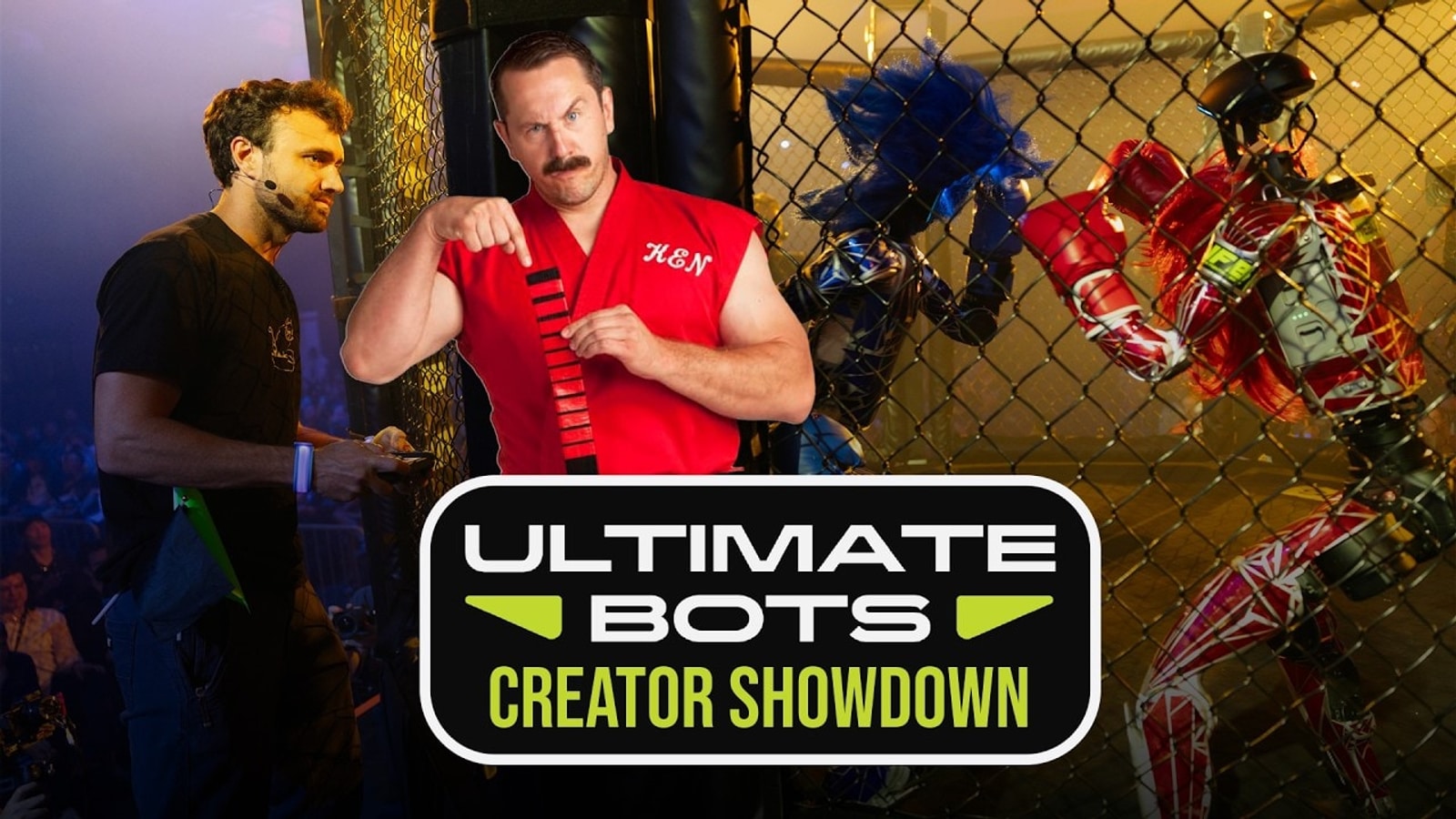
Ultimate Bots is answering the same question from the other direction. Its second season begins October 1 and is scheduled to run through March 31, 2027. The league says it will field four permanent teams, supply every team with a Unitree G1, and distribute a $100,000 prize pool across the season. Participants are split into “pilots,” who drive the humanoids in the arena, and “ghosts,” who build the physical-AI stack behind them.
That separation changes what a team is. A traditional combat-robot team builds a machine and then drives the machine it built. Ultimate Bots can hold the body constant and let human operation, motion programming, perception, control and tactical design become the variable. The platform is league equipment. The competitive product is what the team can teach, script or coax that platform to do.
The rulebook confirms that the league is thinking beyond a sequence of one-on-one boxing exhibitions. Punches can win a point for a round. A score zone activates forty-five seconds into the round and can award a separate point to either team. A knockout ends the round but not the match. Kicks unlock in the third round. Between fight blocks, a K1 race can contribute as many as six points to the larger team contest, with a one-point penalty for every fall.
Captains can also alter the scoring. A lime bonus flag doubles the value of a fight, either before it starts or after the first round. A black flag calls a captain's duel in which the winner gains two points and the loser drops two. The final round of the eighth match is automatically doubled, while a tie sends the game to sudden death in a format selected by the team that scored most recently.
Purists may look at that and see too much machinery around the machinery. They are not entirely wrong. A good sport should be explainable without a tax attorney and a laminated flowchart. But the rules are doing something technically useful: they prevent the strongest punch routine from becoming the only path to victory.
A team has to manage mobility, target acquisition, balance, aggression, zone control and recovery. The K1 race rewards locomotion. The score zone rewards navigation and timing. Punch rounds reward contact. The third-round kick rule raises the control difficulty after the machine has already absorbed damage and battery drain. A captain who doubles a bout is making a tactical judgment about which robot, pilot and software stack is actually performing well that night.
That is closer to a robotics decathlon than mechanical boxing. It also produces better development pressure. If the league only rewards strikes, teams will optimize strike routines. If a season rewards movement, recovery, positioning and contact under one scoring system, the software has to become more general without pretending the machine has already achieved general autonomy.
URKL remains the most physically imposing branch. Its July debut in Shenzhen placed 32 teams on standardized EngineAI T800 humanoids roughly human height, producing a competition in which the robots could punch, kick, fall, recover and, in the most widely circulated sequence, continue fighting after one machine lost its head assembly. The theater was obvious. The engineering underneath it was more important.
A common T800 body means teams cannot win by showing up with a radically different frame. They have to extract performance from motion libraries, controller tuning, timing, balance, perception and tactics. In principle, that makes the contest easier to compare. When two teams use the same platform, a difference in performance points toward software, training, operator judgment or setup rather than a hidden hardware advantage.
Standardization also makes failure more informative. If the same joint repeatedly overheats across teams, the league has discovered a platform limit. If some teams recover from identical falls and others do not, the difference is likely in control or motion strategy. If head-mounted sensing can disappear without immediately ending the bout, the machine's control architecture is revealing how much state estimation remains available elsewhere in the body.
That last point is why the decapitation clip mattered beyond spectacle. A human losing the head portion of the sensing stack is not a combat scenario; it is a funeral. A robot can distribute sensing, computation and balance information through the torso and joints. A rule set can therefore allow the fight to continue after damage that looks theatrically terminal while still leaving the machine able to execute limited behavior. Robot combat is going to produce visual analogies to human injury that are mechanically misleading. Coverage has to resist treating every familiar silhouette as familiar anatomy.
The three leagues also occupy different places on the autonomy ladder. NHRL is explicitly radio controlled, with mandatory fail-safe testing. Ultimate Bots describes pilots driving robots while ghosts develop the physical-AI layer. URKL's public presentation emphasizes team-developed behavior and control on a common humanoid, but the debut should not be mistaken for proof that independent robots are reading opponents and inventing fight strategy on the fly.
Teleoperation is not a defect in the sport. Formula racing does not become technologically uninteresting because a human is in the car. The honest question is where human control ends and machine control begins. A pilot may choose when to attack while a low-level controller stabilizes the body, executes a learned strike and handles recovery. The visible movement can therefore combine human tactics with machine balance and motor control. Calling the whole performance either “human controlled” or “autonomous” throws away the architecture.
That architecture should become part of the scorecard. Leagues ought to disclose control mode, communications constraints, allowed preprogrammed routines, onboard perception, offboard compute, recovery assistance and intervention rules. A robot that chooses an action from onboard sensing is demonstrating something different from a robot replaying a triggered animation. Both may be entertaining. They are not the same technical achievement.
Safety will also define which branch survives. Destructive wheeled robots live inside hardened enclosures because their weapons can throw metal with enough energy to ruin a nearby spectator's afternoon permanently. Humanoid leagues trade lower weapon energy for a more complicated fall envelope. A 35-kilogram G1 or much heavier T800 does not need a spinning bar to injure a person. It only needs to topple in the wrong direction or throw an unexpected limb through an opening.
Standardized platforms make some safety problems easier. The league can characterize known loads, establish inspection procedures, stock common parts and define an emergency-stop system around one architecture. They also create common-mode risk. A control defect, battery problem or structural weakness can exist across every team at once. The same sameness that makes competition fair can make failure contagious.
Repair economics will be the less glamorous test. A season is not built from highlight clips. It is built from replacement actuators, bent brackets, calibration time, battery cycles, shipping cases, technicians and enough spare machines to prevent one ugly fall from canceling the card. NHRL builders already understand that the pit is part of the event. Humanoid leagues now have to turn vendor platforms into maintainable sports equipment rather than precious demonstrations.
The competitive data could be valuable far outside entertainment. Combat forces rapid state estimation under contact, repeated recovery, degraded sensing, unpredictable loads and interaction with another moving machine. Racing adds gait consistency and fall cost. Zone control adds navigation and timing. None of this directly produces a useful factory worker or battlefield robot, but it does generate failure cases that choreographed demos politely avoid.
That is why Cyberdelia treats robot sports as more than a novelty beat. A public competition supplies rules, repeated trials, opponents and a scoreboard. It turns “look what our robot can do” into “show us again, under the same constraints, against somebody trying to stop you.” Marketing can stage a perfect performance. Sport makes the machine repeat itself after the other machine punches it in the face.
The next dates are now clear enough to watch. Ultimate Bots Season 2 opens October 1 and will reveal whether its four-team, league-assigned-platform model can sustain a six-month season. NHRL's October 3 open qualifier and November 7 third pro-tour round will show whether the professional layer can coexist with the open builder pipeline that feeds the sport. URKL's next meaningful update should be judged by published rules, control disclosures, repeatable bouts and season structure rather than another viral kick.
Robot fighting is not marching toward one inevitable format. It is branching. NHRL asks teams to build the best complete fighting machine. URKL asks what teams can do when the full-size body is standardized. Ultimate Bots asks whether standardized humanoids can support team strategy across several events. The machines all enter an arena, but the leagues are measuring different things.
That is how a novelty becomes a sporting ecosystem. The rules stop being scenery. They become the instrument that decides which technology gets better.
The strongest development is not that robots are hitting harder. It is that leagues are finally making different engineering claims falsifiable. Custom destructive combat measures the whole machine. Standardized humanoid combat measures control and training on a common body. Multi-event team play measures whether one platform can remain useful across movement, contact and tactical objectives. Keep the scoreboards separate, publish the control architecture, and the sport can become an unusually honest robotics laboratory.