

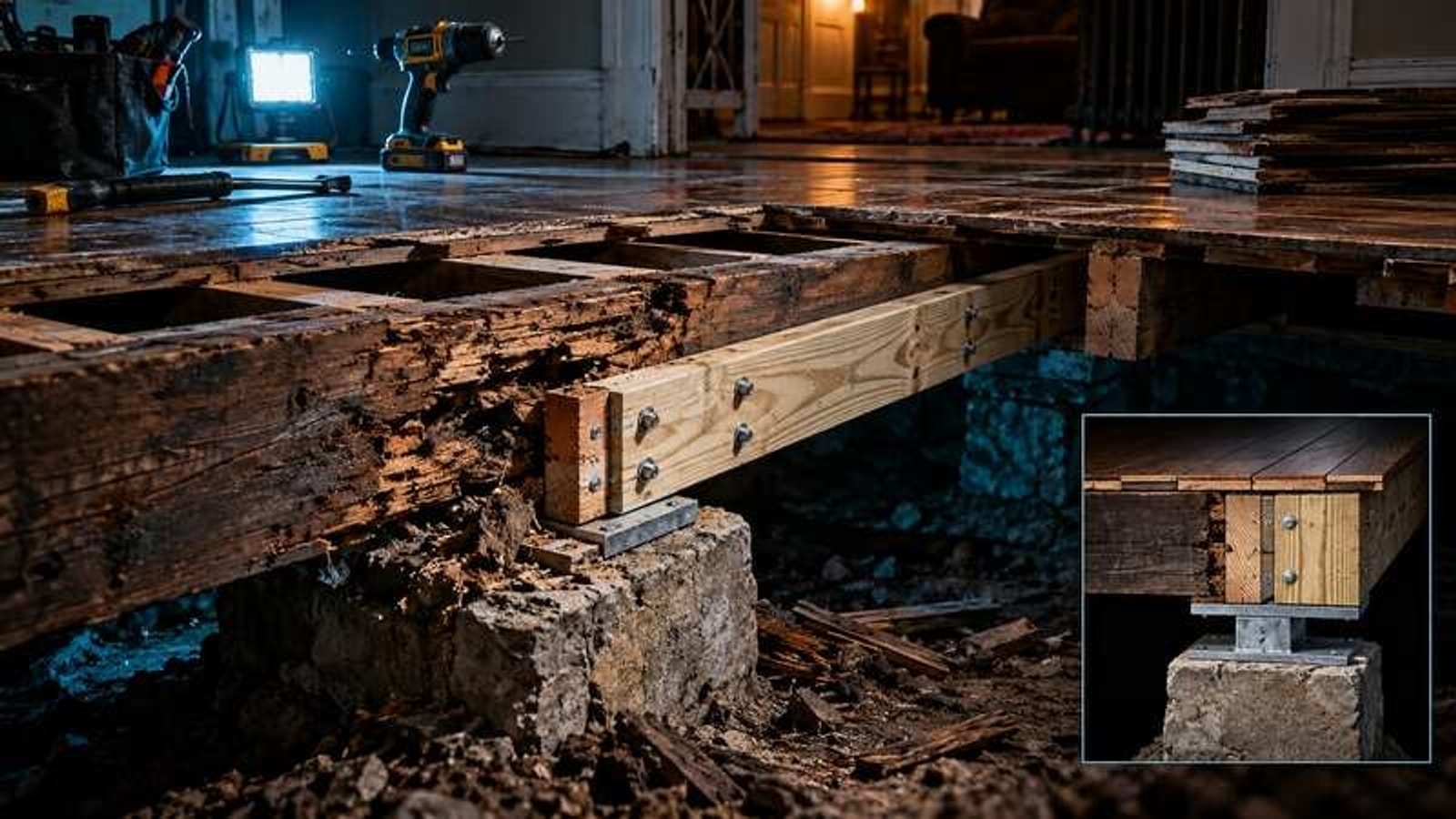
The seductive mistake in old-house repair is to stop at the first surface that looks flat. A piece of carpet comes up. The room looks ugly but manageable. Then the tack strip comes out, the edge opens, and somebody discovers the previous repair ended exactly where the next person would have had to do real work.
That is not unusual. It is also not a reason to repeat it.
Expose the whole failure.
Once rot, swelling, missing subfloor, bad seams, or debris is found, the useful question is not “How little can I remove?” It is “Where does sound structure actually begin again?” The answer determines every cut after that. A clean rectangular opening with known support is easier to repair than a prettier opening that leaves weak material trapped under the new work.
Clean bearing surfaces are part of the structure.
Old MDF, particle board, broken fasteners, carpet debris and half-rotted fragments under a wall or plate can steal the exact fraction of an inch that prevents a replacement panel from seating correctly. Cleaning that cavity is slow, unglamorous work. It is also the difference between a fitted repair and a sheet that rocks, bridges or carries load through places it was never meant to.
Orientation is a design decision, not a ritual.
With salvaged sheet goods, the perfect factory layout may no longer be available. That does not mean orientation stops mattering. It means every piece has to be judged by where its edges land, what supports them, how loads cross the patch, and whether blocking is needed. Reuse is engineering under constraint. It is not permission to make the structure improvise on your behalf.
The budget changes the method.
When new plywood is expensive, careful salvage matters. Sound pieces can be rotated, trimmed and redistributed. Scrap lumber can become blocking. Time can be spent fitting instead of buying. The trade is straightforward: less money usually means more inspection, more cutting, more cleaning and more patience.
That is acceptable. Hidden weakness is not.
Structural repair is a truth problem before it is a carpentry problem. Open the system until the load path is visible. Preserve what is actually sound. Replace what is not. Do not let finish work become a witness-protection program for bad structure.
Field note: This dispatch documents repair logic, not a site-specific engineering certification. Load-bearing walls, major framing damage, foundation movement, severe rot, or uncertain structural paths can require qualified local inspection.