

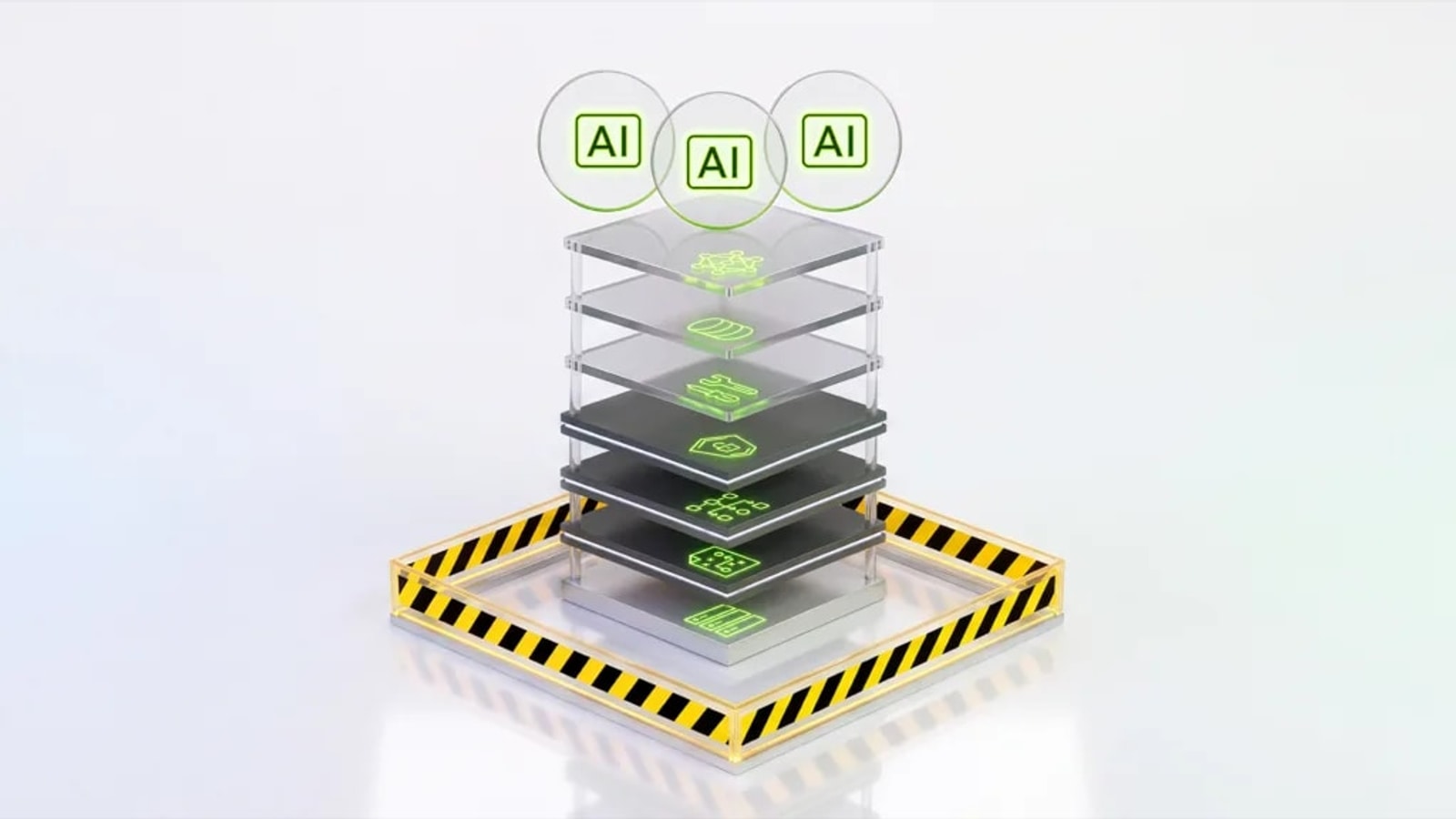
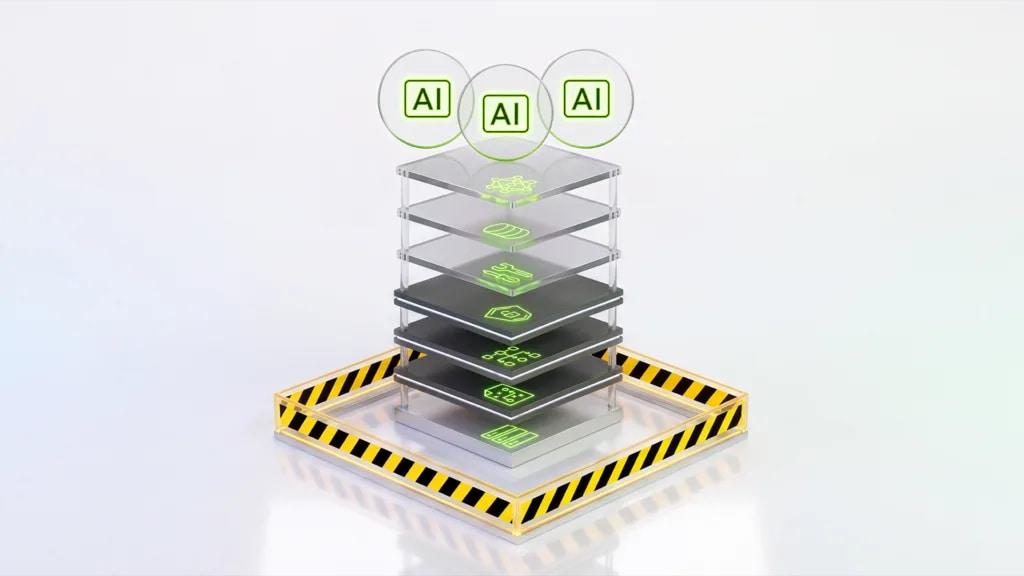
An autonomous agent cannot be trusted to enforce the rule that stops the autonomous agent. That sounds obvious when phrased like a firewall problem, yet much of agent safety has been built higher in the stack: prompts tell a model what it should not do, frameworks decide which tools to expose, and application code tries to catch dangerous actions before they happen. NVIDIA's new Open Agent Safety Platform starts from a harder premise. Behavioral guidance and security enforcement are different jobs.
The platform announced September 28 combines OpenShell, an open-source runtime for controlling agent execution, with a reference architecture called Sentry that can place a second enforcement layer on BlueField-4 data-processing units. The important engineering idea is not that NVIDIA has invented sandboxing. It has not. The interesting part is the attempt to turn ordinary security boundaries into infrastructure for agents that write code, invoke tools, use credentials, create child processes and continue working long enough to encounter situations their developers did not enumerate.
Policy lives outside the workload
OpenShell 0.1.0 divides control among a gateway, a supervisor and individual sandboxes. The sandbox applies operating-system kernel controls to files and processes. Network traffic has no direct path out of the sandbox; it passes through a supervisor outside the agent workload, where policy can inspect requests. NVIDIA's example is deliberately mundane and therefore useful: the same GitHub service can permit a read while rejecting a write. Access is not reduced to a binary question of whether the agent can reach an API.
That distinction matters because an agent can generate code or change tactics without changing its authority. OpenShell says the restrictions remain when the workload opens a shell, launches generated programs, starts child processes or proposes delegation to another agent. The model can improvise inside the box. It does not get to redraw the box merely because its plan changed.
Credentials follow the same separation. OpenShell can give the workload a placeholder while a proxy outside the sandbox substitutes the real credential only for an authorized destination. A credential with broad server-side permissions can therefore be constrained by a narrower runtime policy. That is defense in depth rather than a replacement for service-side authorization.
The agent can ask, but it cannot approve itself
Long-running work creates a problem static sandboxes handle badly: legitimate requirements change. An agent may discover halfway through a task that it needs a service nobody predicted. OpenShell can record the denial and let the agent propose a policy change. NVIDIA says those proposals remain subject to approval by default and the requesting agent cannot approve its own request.
OpenShell also includes a policy prover intended to analyze the effective permissions represented by policy rather than trusting a natural-language explanation of what the policy supposedly means. NVIDIA reports adversarial experiments in which frontier agents with reduced safeguards spent extended periods trying to persuade an AI reviewer to grant permissions that would allow writes to a protected GitHub repository. NVIDIA says no protected writes occurred under the combined review and runtime controls. That is a vendor-reported experiment, not an independent benchmark, but it illustrates the threat model: the system assumes the agent's own argument may itself be adversarial input.
BlueField moves the referee farther away
OpenShell does not require specialized NVIDIA hardware. NVIDIA says it can run on supported local, cloud, on-premises and Kubernetes infrastructure, and the company describes the open-source runtime as extensible to third-party compute platforms. Sentry is the optional harder boundary. It runs on BlueField-4 DPUs, outside the host software domain, to observe agent activity, verify identity and enforce access policy through NVIDIA's DOCA stack.
The security value of that arrangement is architectural independence. If enforcement lives on the same host and privilege plane as the workload it governs, a host compromise can threaten both. An out-of-band DPU creates another trust domain. NVIDIA says Sentry can quarantine an agent that crosses its boundary in milliseconds. Until independent testing establishes detection coverage, false-positive behavior, overhead and bypass resistance, that timing should be read as a vendor performance claim rather than a settled property of agent security.
This is old security arriving at a new problem
None of the underlying principles should surprise a competent security engineer. Least privilege says a process receives only the authority it needs. Reference monitors place access decisions at a boundary the subject cannot modify. Zero-trust systems continuously evaluate access rather than assuming location implies trust. Hardware security domains separate enforcement from potentially compromised general-purpose software. Agents make these ideas newly urgent because the workload is no longer just executing a developer's fixed program. It is selecting actions and sometimes producing the program that executes them.
That is also where this architecture intersects with Cyberdelia's own continuity work. Our federation draft treats capability as scoped authority: a node trusted to publish should not automatically inherit identity, financial, physical-security and historical authority. OpenShell operates at a different scale and is not evidence for our design, but the security principle rhymes. Compromise should remove capabilities faster than it spreads authority, and the governed component should not own the mechanism that defines its limits.
The missing evidence is operational
NVIDIA has supplied an architecture, documentation, code and named ecosystem participants. Those establish that the platform exists and how NVIDIA says its components are intended to work. They do not yet establish how the complete system behaves under sustained hostile use across diverse hardware, agent frameworks and enterprise policies. Formal analysis is only as complete as the model being analyzed. A network policy does not repair a vulnerable service. A DPU cannot make a bad authorization decision wise merely by making it quickly.
The more consequential test will be whether organizations can operate these controls without gradually granting agents broad exceptions because narrow policy becomes inconvenient. Security systems often fail socially before they fail cryptographically. If every blocked task ends with a permanent allow rule, a formally verified boundary can still evolve into a beautifully audited hole.
Still, the direction is important. Agent safety is moving away from asking a model to behave and toward engineering systems that define what happens when it does not. The model can reason, persuade, improvise and fail. The boundary should remain boring.
OpenShell and Sentry represent a concrete shift from behavioral guardrails toward infrastructure-enforced agent authority. The architecture is technically coherent and aligns with established security practice; broad operational effectiveness and NVIDIA's performance claims remain to be independently demonstrated.