
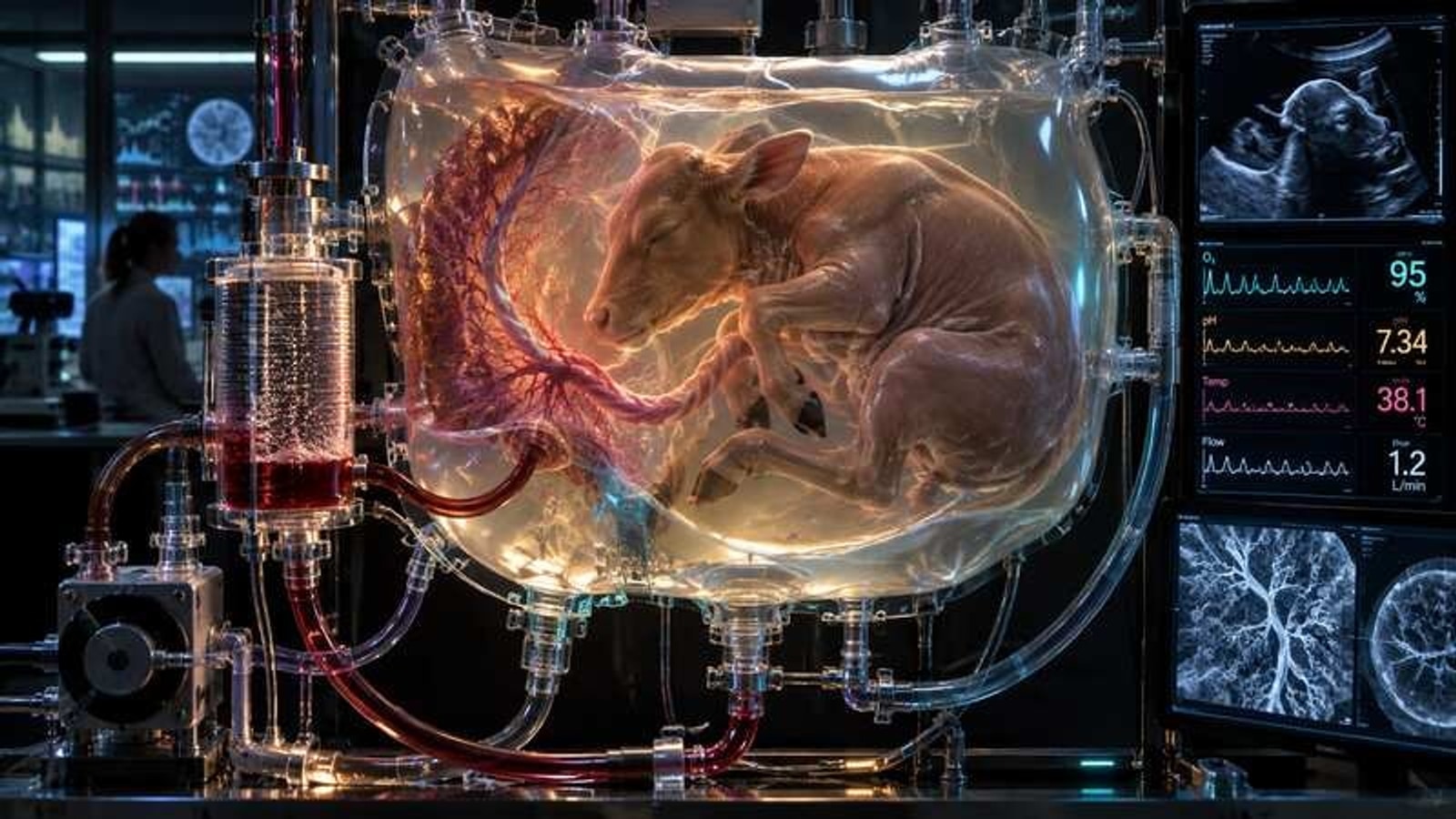
DEVELOPMENTAL BIOLOGY / ARTIFICIAL GESTATION / DE-EXTINCTION
The Artificial Womb Problem.
Editing a mammoth-like genome may be easier than growing the animal. Elephant gestation lasts nearly two years, the placenta is an active biological organ, and no machine has yet demonstrated complete elephant-scale gestation from embryo to birth.
By Cyberdelia Research Desk · September 10, 2026 · Method: developmental-biology and reproductive-technology synthesis
The embryo is not the finish line
De-extinction publicity often concentrates on genes because genes are legible. They can be sequenced, compared, edited and represented as clean diagrams. Gestation is harder to compress into a headline because it is an extended, dynamic physiological negotiation between fetus, placenta and mother.
For mammoth work, that distinction is decisive. Even if researchers produce a perfectly edited elephant cell carrying every intended mammoth-associated variant, they still have to create an embryo, establish a viable pregnancy, maintain development for roughly twenty-two months and deliver a healthy calf.
That is not a container problem. A uterus is not an incubator bag with plumbing. It participates continuously in hormonal signaling, immune regulation, nutrient exchange, waste removal, oxygen delivery and mechanical support. The placenta is not a passive filter either. It is a transient organ built jointly from fetal and maternal biology.
Why elephants make this unusually difficult
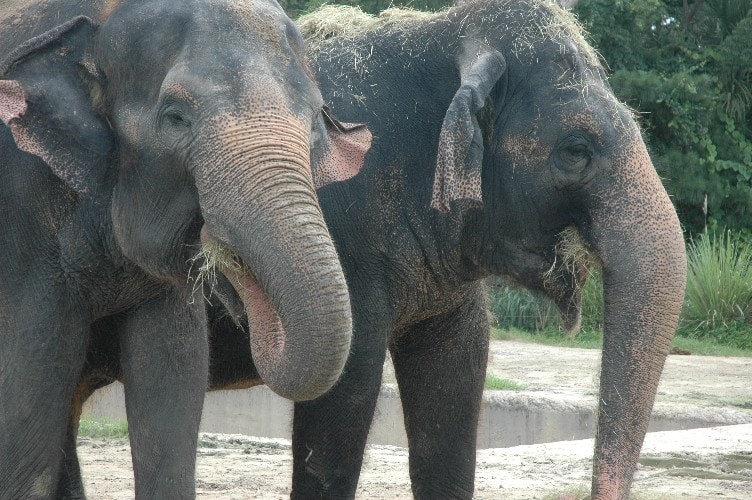
Elephants have the longest gestation of any living land mammal. Their calves are large, neurologically developed and behaviorally dependent on complex maternal and herd relationships after birth. Asian elephants are also endangered, which immediately limits how aggressively reproductive experimentation can be conducted.
A mouse pregnancy lasts around three weeks. An elephant pregnancy takes almost two years. If a gene-editing hypothesis produces a developmental failure late in gestation, the experimental cost is not merely time. It includes animal welfare, veterinary risk and the reproductive burden placed on a highly intelligent endangered surrogate.
This is why the woolly mouse mattered more as an engineering shortcut than as a spectacle. Researchers could test some hair and metabolism hypotheses in a mammal with a fast reproductive cycle instead of waiting nearly two years for every elephant-level experiment.
Artificial gestation changes the scaling equation
Colossal has publicly described artificial-womb technology as a long-term necessity for its mammoth ambitions. The logic is straightforward. If the objective is eventually to establish a population rather than produce one demonstration calf, relying permanently on endangered elephant surrogates becomes ethically and logistically difficult.
The company has described a system using tightly monitored fluid exchange, nutrient and gas management, sensor feedback and automated control. In 2026, company leadership said the program had cleared many technical hurdles but still had at least one major barrier before achieving complete artificial mammalian gestation. Those are company-reported milestones, not independent proof that elephant-scale ectogenesis is ready.
That distinction matters because the phrase "artificial womb" covers multiple levels of capability. Supporting a premature fetus for part of development is not the same as taking an early embryo through implantation, placentation, organogenesis, fetal growth and birth entirely outside a living mother.
Partial ectogenesis is real
Researchers have already built systems that can sustain developing animal fetuses under specialized conditions. Experimental "biobag" systems for premature lambs, for example, have demonstrated that fetal development can continue in an artificial fluid environment while gas exchange occurs through an extracorporeal circuit.
Those experiments are important because they show that some functions normally provided by the uterus can be engineered. But they start after many of the hardest developmental transitions have already occurred. Implantation and early placental development remain fundamentally different problems.
A complete artificial gestation system would need to reproduce an enormous sequence of changing conditions rather than maintain one stable recipe. Oxygen requirements change. Nutrient needs change. Hormonal states change. Waste products change. Mechanical stresses change. The fetal cardiovascular system transforms over time.
Building such a system is therefore a control problem as much as a biological one.
The placenta is the hidden machine
In natural pregnancy, the placenta continuously adapts to fetal demand and maternal physiology. It regulates transport and secretes signaling molecules. It also helps manage a difficult immunological paradox: the fetus is genetically distinct from the mother, yet must not be rejected like foreign tissue.
Any artificial system has to decide which placental functions remain biological and which are replaced mechanically. One strategy may preserve a functioning biological placenta and connect it to external circulation. Another might someday engineer synthetic interfaces capable of replacing more of the placenta's functions directly.
Neither is trivial. Blood contacting artificial surfaces can clot or trigger inflammation. Pressure and flow must be controlled. Gas exchange has to occur without damaging delicate vessels. Infection risk has to remain extremely low for months.
For an elephant-sized fetus, every one of those problems scales.
Artificial gestation does not eliminate developmental uncertainty
It is tempting to imagine that once pregnancy moves into a machine, reproduction becomes standardized. In reality, artificial gestation may increase observability without eliminating biological variation.
That observability could be extraordinarily valuable. Sensors might continuously measure oxygen, metabolites, hormones and fetal activity. Automated systems could detect deviations earlier than conventional pregnancy monitoring. Researchers could build detailed developmental baselines and compare engineered embryos against them.
But more data does not mean perfect control. Developmental systems contain feedback loops we do not fully understand. Correcting one variable may perturb another. Some maternal signals may be subtle, transient or unknown. A machine can only regulate variables designers know how to measure and interpret.
The ethical argument is not one-sided
Artificial wombs sound dystopian almost automatically because humans are exceptionally good at imagining industrialized reproduction before breakfast. But in conservation biology, the technology could also reduce harm.
If artificial gestation can replace endangered surrogate pregnancies, it could lower risk to living animals. It might help preserve species whose surviving females are too few or medically unsuitable to carry enough pregnancies. It could make use of banked genetic material that would otherwise remain biologically inaccessible.
The danger is that reducing reproductive bottlenecks could also encourage more aggressive experimentation. If embryos become easier to generate and gestate, welfare standards must not become weaker simply because the process looks more automated.
The proper metric is not how many animals can be produced. It is how many healthy animals can be produced with acceptable welfare costs and justified conservation value.
Surrogates may still come first
As of 2026, Colossal continues to discuss surrogate elephants for the earliest mammoth-proxy births while developing artificial gestation as a later scaling technology. That is a revealing signal about maturity. The natural uterus remains the proven system.
For the first generations, researchers may need the biological environment of an elephant pregnancy precisely because they do not yet know which variables an artificial system would have to reproduce. Early surrogate pregnancies could therefore serve two roles at once: producing animals and generating detailed physiological datasets for future artificial gestation.
That prospect raises its own welfare constraints. Instrumentation and monitoring must remain compatible with the health of the surrogate and fetus. The research value of data cannot justify treating endangered elephants as disposable development platforms.
Cyberdelia assessment
The artificial womb is one of the most consequential pieces of the de-extinction puzzle because it sits between genome engineering and population-scale biology. A single mammoth-like calf might be achievable with surrogate reproduction. A self-sustaining population demands a reproductive system that can operate ethically at much greater scale.
That does not mean artificial wombs are inevitable. Improvements in elephant IVF, stem-cell-derived gametes, embryo transfer and conservation breeding might reduce the number of surrogates required. Population goals may also change if ecological studies conclude that only limited numbers of proxies are justified.
The central point is that de-extinction cannot be evaluated by DNA editing alone. The organism has to develop. Development requires an environment. Rebuilding that environment may prove as technically demanding as rebuilding the genome.
Uncertainty and falsification
Claims that complete artificial elephant gestation is near should be treated as provisional until an independently documented system takes an embryo or sufficiently early fetus through the relevant developmental stages to healthy birth. Partial fetal support, successful sensor control or company prototypes are meaningful milestones but not substitutes for that demonstration.
Source trail
Sources include Colossal's 2026 artificial-womb project descriptions for company-reported targets; Nature reporting on elephant pluripotent stem cells and mammoth-development challenges; established reproductive-biology literature on placental function and ectogenesis; and public-domain elephant imagery from Wikimedia Commons.
Corrections: Cyberdelia updates technical features when evidence or project milestones change.