
DE-EXTINCTION / DEVELOPMENTAL BIOLOGY / JURASSIC PARK SCIENCE
The Genome Is Not the Animal.
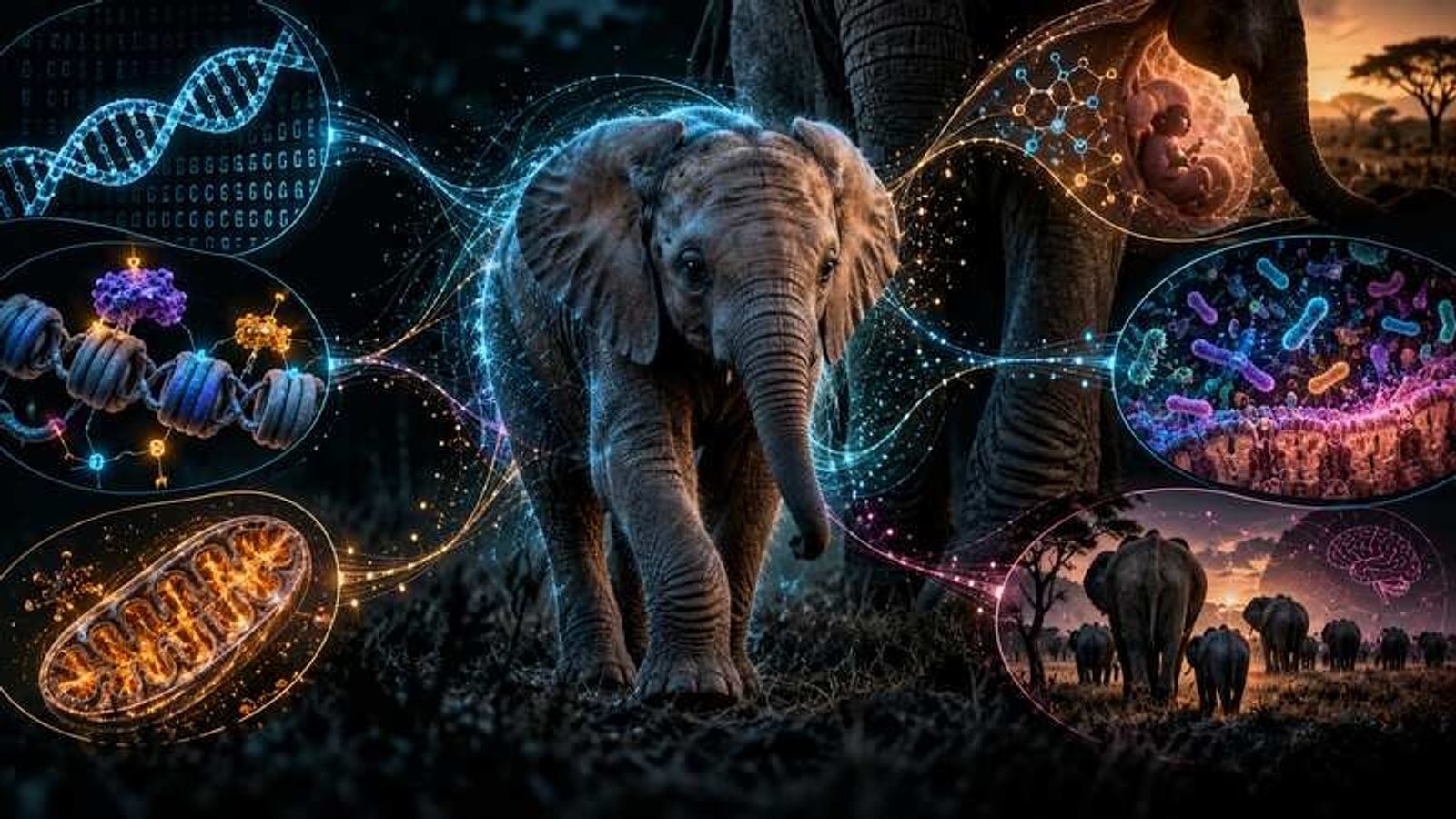
A genome is an instruction set embedded inside a developmental system. Reconstructing extinct DNA is powerful, but it does not automatically reconstruct the embryo, uterus, microbiome, social world or ecosystem that once turned that DNA into a living species.
By Cyberdelia Research Desk · September 10, 2026 · Method: developmental-systems synthesis

The seductive mistake
Modern biotechnology encourages a particular kind of reductionism. DNA can be sequenced, compared, edited and synthesized, so it is tempting to talk as though an animal is simply a genome with legs. That simplification is useful for some engineering tasks. It is also wrong in exactly the places de-extinction becomes hardest.
A fertilized egg contains DNA, but the genome does not execute itself in isolation. Development depends on chemical gradients, maternal signaling, chromosome packaging, timing, mechanical forces, placental exchange, mitochondrial function and feedback between growing tissues. Genes switch on and off in specific places and at specific times. The same DNA sequence can produce different outcomes depending on regulation and environment.
Jurassic Park treated the missing sequence as the central obstacle. Fill the gaps and the dinosaur appears. Real developmental biology turns that premise inside out: even an excellent genome reconstruction still has to be interpreted by living cellular machinery that belongs to some organism in the present.
Sequence is only one layer of information
Genes are stretches of DNA that can contribute to proteins or functional RNA, but much of organismal complexity comes from deciding when, where and how strongly genes are used. Regulatory sequences, chromatin structure, DNA methylation, transcription factors and three-dimensional chromosome organization help control that process.
The 2024 reconstruction of chromosome architecture from roughly 52,000-year-old mammoth skin matters for this reason. Researchers did not simply recover additional letters of mammoth DNA. They found traces of the way ancient chromosomes were physically organized inside nuclei. Using a method called PaleoHi-C, the team identified structural features analogous to chromosome territories, domains and loops. Those features can influence which genes are accessible and which are silent.
The result does not give scientists a complete mammoth epigenome. It demonstrates that exceptionally preserved tissue may contain historical information about genome regulation that ordinary sequencing misses. For de-extinction, that means the target can occasionally become richer than a list of nucleotide differences.
The maternal environment is part of the experiment
A mammoth-like embryo generated from edited elephant cells would still have to develop somewhere. Colossal has discussed elephant surrogates for early births and artificial gestation as a longer-term goal. Either route exposes the same biological reality: the uterus and placenta are active participants in development.
The placenta regulates nutrient transfer, gases, hormones and immune interactions. Maternal physiology changes throughout gestation. Fetal tissues signal back. Development is therefore a conversation between genomes and bodies, not a one-way software installation.
If an engineered embryo carries variants affecting cold adaptation, hair, fat deposition, skull shape or hemoglobin, those edits must function inside elephant developmental timing and elephant maternal physiology. Some traits may transfer cleanly. Others may interact with genetic background in unexpected ways. A variant that contributed to a mammoth phenotype in a mammoth genome is not guaranteed to produce the same result in an elephant genome containing millions of other differences.
This is called epistasis in one of its broad senses: the effect of a genetic change can depend on what other genetic variants are present. Multiplex editing therefore increases capability and uncertainty simultaneously. Each additional edit is not merely another independent switch. It enters a network.
Then comes mitochondria
Nuclear DNA receives most of the attention, but mammalian cells also contain mitochondrial DNA. In cloning approaches based on nuclear transfer, the nuclear genome comes from one source while the egg contributes mitochondria and much of the cytoplasmic machinery. A mammoth proxy created through elephant oocytes would therefore inherit living-elephant cellular components unless those components were separately engineered.
Whether that distinction matters strongly for a given trait depends on the trait. Mitochondria are central to cellular energy metabolism and interact extensively with nuclear genes. A cold-adapted elephant might function perfectly well with elephant mitochondria. Or some combinations might alter metabolism in ways that only become visible during development, exercise, fasting or cold exposure.
The point is not that mitochondrial mismatch makes the project impossible. It is that "percent mammoth DNA" is a poor summary of biological identity.
The microbiome is not in the genome
Animals are ecosystems. Their skin, mouths and gastrointestinal tracts host microbial communities that influence digestion, immune development and metabolism. Herbivores in particular depend heavily on gut microbes to process plant material.
No frozen mammoth specimen provides a living, complete mammoth microbiome ready for transplantation. Ancient DNA and preserved intestinal material may reveal components of past microbial communities, but a twenty-first-century mammoth proxy will acquire microbes from contemporary surroundings, caregivers, food, other elephants and deliberate veterinary interventions.
That means even an exceptionally mammoth-like genome would live inside a partly modern biological consortium.
Behavior is another missing inheritance system
Elephants are unusually inconvenient animals for simplistic resurrection stories because they are intelligent, long-lived and profoundly social. Calves learn from mothers and other herd members. Migration routes, responses to threats, communication and foraging behavior are shaped by both biology and experience.
A mammoth calf cannot learn mammoth culture from mammoths if no mammoth culture remains.
Researchers could raise mammoth proxies among elephants, allowing social knowledge to transfer from the closest living relatives. Some behaviors might emerge spontaneously from morphology and physiology. Others might never resemble extinct mammoth behavior because the learning environment is different.
This is not a minor philosophical problem. If the stated objective includes ecological restoration, behavior determines whether an animal actually performs the intended ecological role. A genetically impressive proxy that does not forage, migrate or interact with vegetation as expected may not recreate the ecosystem effects used to justify its release.
What counts as the same species?
Species identity is already messy among living organisms. Biologists use multiple species concepts involving reproductive isolation, ancestry, ecological niche and morphology. De-extinction adds organisms whose ancestry is deliberately engineered.
Imagine an animal whose nuclear genome remains overwhelmingly Asian elephant but includes dozens of mammoth-derived sequence states. It has thick wool, short ears, altered fat distribution, cold-adapted hemoglobin and mammoth-like skull morphology. It can live in Arctic conditions and perhaps interbreed with elephants. What is it?
Calling it a mammoth emphasizes phenotype and ecological function. Calling it an engineered elephant emphasizes ancestry. Calling it a mammoth proxy emphasizes both the achievement and the discontinuity.
The IUCN preference for "proxy" language is useful because it prevents a scientific category from being decided by branding. A proxy can be extraordinary without pretending historical continuity has been restored.
Development is where edited cells become a real test
In 2024 Colossal reported successful derivation of induced pluripotent stem cells from Asian elephant cells. That matters because pluripotent cells can, in principle, be differentiated into multiple cell types and may support reproductive technologies such as generating gametes or constructing embryos. Outside researchers nonetheless stressed that creating elephant iPSCs is far removed from generating healthy mammoth calves.
The reason is developmental competence. A cell can carry the intended sequence and still fail to produce a healthy embryo. Reprogramming can leave abnormal epigenetic marks. Chromosomes can be damaged. Gene dosage can be wrong. Placental development can fail. Cloning experiments across mammals have repeatedly shown that nuclear transfer and embryo manipulation can produce low success rates and developmental abnormalities.
De-extinction therefore has a long verification chain: sequence the target, select variants, edit cells, confirm edits, test cell function, generate embryos, confirm development, establish pregnancy, survive gestation, achieve birth, monitor neonatal health, measure adult phenotype, assess fertility and only then ask ecological questions.
Cyberdelia assessment
The genome is necessary but insufficient. Any serious claim of de-extinction should specify which layer has actually been recreated: sequence, gene regulation, phenotype, physiology, reproduction, behavior or ecological function.
This framework prevents a common category error. A successful set of gene edits is evidence about engineering. A healthy birth is evidence about development. A cold-tolerant adult is evidence about physiology. A reproducing population is evidence about lineage continuity. Ecosystem change is evidence about ecological function. None of those achievements automatically proves all the others.
The deeper lesson from modern biology is that heredity extends beyond a DNA string. Developmental context, cellular state, maternal environment, microbes, learning and ecology all participate in making an animal what it is. De-extinction can reconstruct portions of that system, but the word "resurrection" hides the amount of new biology being created along the way.
Uncertainty and falsification
The relative importance of these missing layers will differ by species and trait. Some organisms may tolerate extensive substitution of developmental context; others may not. Mammoth-proxy projects will provide direct evidence only when edited elephant embryos progress through gestation and the resulting animals can be physiologically characterized.
Source trail
Sources include the 2024 mammoth PaleoHi-C work summarized by Nature Genetics and NSF; Nature reporting on elephant induced pluripotent stem cells; Nature Biotechnology reporting on Colossal's mammoth strategy; IUCN guidance on proxies of extinct species; and primary/company technical descriptions used only for stated project targets.
Corrections: Cyberdelia updates technical features when primary evidence changes. Contact routes are listed on the site.