

Some of the most consequential engineering equations are not universal laws handed down by first principles. They are disciplined descriptions of how a particular class of material behaves under particular conditions. Load a metal, deform it quickly, heat it, cycle it or hold it under stress, and a constitutive model tells the simulation how that material should respond.
If the equation is wrong, the rest of the analysis can be immaculate and the answer still drifts. A crash model can misstate the force path. A forming simulation can predict the wrong strain. A battery model can miss how soft lithium moves under pressure and temperature. The mesh, conservation equations and numerical solver do not rescue a bad description of the material inside them.
Researchers Hao Xu, Yuntian Chen and Dongxiao Zhang have published an approach called GraphED that attacks this problem with equation discovery. It does not train a neural network and ask engineers to trust the output surface. It searches through symbolic expressions, fits material-specific coefficients and returns compact analytical formulas. In the authors' reported tests, those formulas matched several solid-mechanics datasets as well as or better than established empirical models.
The easy headline is that AI discovered new laws of physics. That is too large. Constitutive laws are material-response models, often empirical or semiempirical, not conservation laws of nature. The paper does not abolish experiments, domain expertise or physical theory. Its real achievement is more useful: it turns machine learning into a generator of explicit, falsifiable engineering proposals.
A constitutive law is the material's part of the simulation.
Mechanics begins with relationships that apply broadly—conservation of mass, momentum and energy; geometric descriptions of deformation; balance laws. Those foundations do not specify how every solid turns strain into stress. Steel, rubber, rock and lithium do not respond identically. Their response depends on composition, microstructure, history, temperature, loading rate and other conditions.
Engineers therefore use constitutive equations. Some are grounded closely in physical mechanisms. Others are phenomenological: a mathematical form is proposed because it captures a recurring shape in experimental data, then coefficients are calibrated for each material. The Johnson–Cook model, widely used for metals under plastic deformation, combines terms for hardening, strain-rate sensitivity and temperature. It is compact and practical, but any fixed form carries assumptions about what relationships are allowed.
Traditional model building puts expert intuition at the search interface. A researcher chooses a family of curves, adds terms suggested by theory or prior work, fits parameters and judges the residuals. That process has enormous value; it also restricts the candidate space to forms a human thought to write down. A flexible neural network can search a much larger functional space, but the resulting mapping may be difficult to inspect and awkward to integrate into legacy finite-element software.
Symbolic regression tries to keep the search while recovering the equation. Give a system variables and permitted operations, and it evolves expressions that fit the observations. The danger is combinatorial explosion: even a small set of operators can produce a ridiculous number of equations, many needlessly complex, numerically unstable or physically absurd.
GraphED is the authors' attempt to make that search both wider and disciplined.
The system searches graphs, then prints equations.
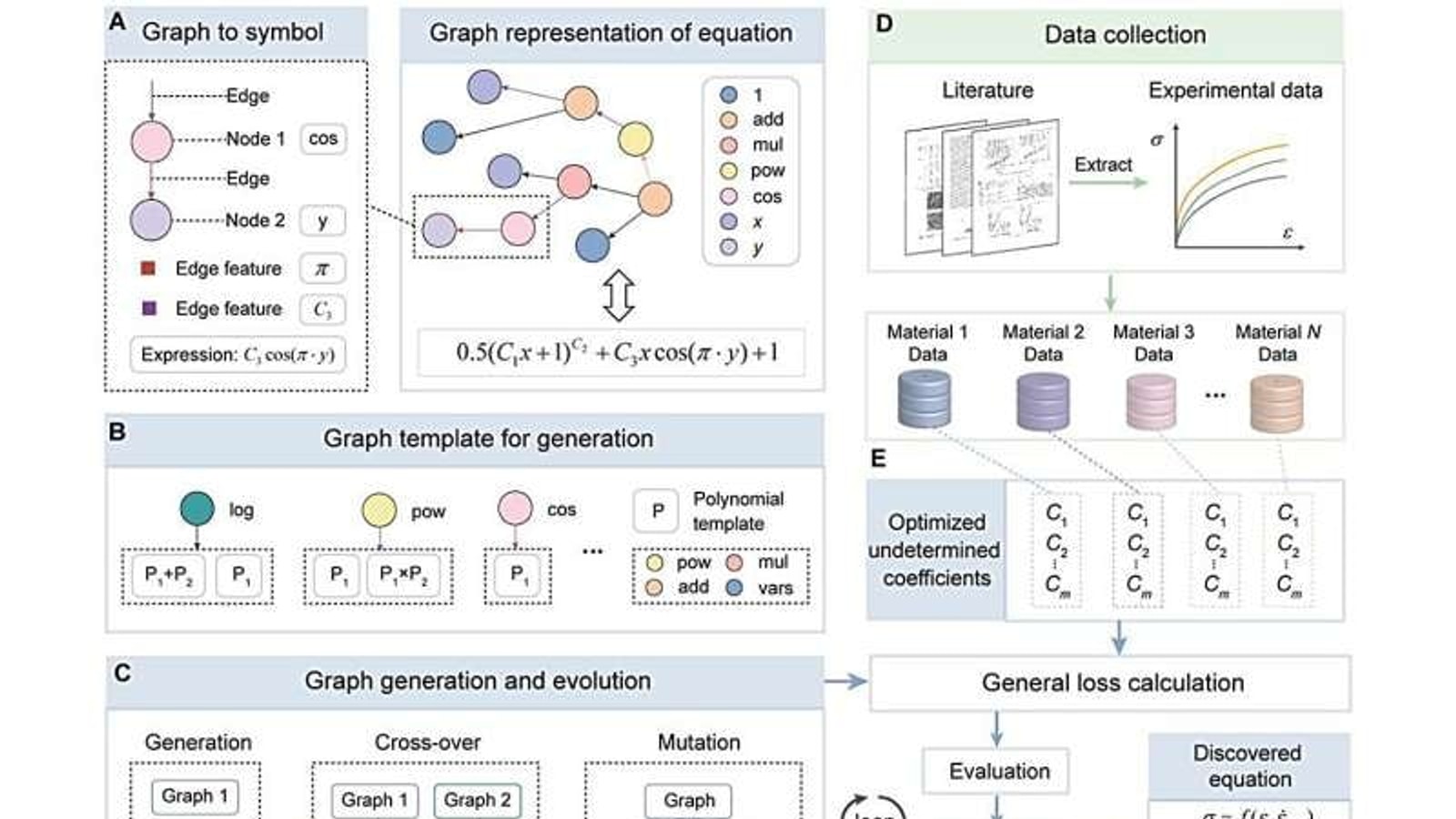
Each GraphED candidate is represented as a directed acyclic graph. Nodes stand for variables or operations. Edges represent computational dependencies. Edge features can carry fixed constants or coefficients that will be learned separately for each material. Shared nodes let a graph reuse a subexpression without reproducing an entire branch, which can make the representation more compact than a conventional expression tree.
The search is not unconstrained. The researchers define graph templates that limit how operators and subgraphs can be assembled. For the reported solid-mechanics cases, the operator set included addition, multiplication, exponentiation, logarithms and powers. Candidate graphs are generated, crossed over and mutated in a genetic-programming process. Their undetermined coefficients are fitted to data, and the resulting errors determine which structures survive and reproduce.
This division is important. The graph describes a common equation form. Its edge parameters allow different materials to inhabit that form with different calibrated values. A single candidate can therefore be judged across many material datasets without pretending that every steel has the same constants. The objective is not one curve that averages incompatible materials. It is one mathematical structure that can be specialized.
The authors fit candidate parameters with the L-BFGS optimization method and use multiple starting points to reduce the chance that a poor local solution kills a promising structure. They limit the number of free parameters—two in the dynamic-increase-factor search and three in the strain-hardening search—to preserve parsimony. An initial population of 300 graphs evolves for 150 epochs in the reported cases.
That is not a machine staring innocently at raw nature. Humans choose the variables, data, operator vocabulary, graph templates, parameter limits, loss function and selection procedure. Those choices are priors. GraphED automates a large search inside the world its designers make available.
The steel results are strong enough to deserve replication.
The first case concerns the dynamic increase factor, or DIF: the ratio used to describe how a material's strength changes as it is loaded faster. The researchers assembled 408 groups of experimental data from 40 materials across strain rates spanning many orders of magnitude. GraphED searched for a common two-parameter form and produced a compact power-exponential relationship.
Against four conventional DIF models, the discovered form produced the lowest reported mean squared error, 6.9 × 10⁻⁴, and an R² of 0.980. The best comparison model, Huh–Kang, also used two material-specific parameters and produced an MSE of 1.2 × 10⁻³. The paper reports that the GraphED form remained effective across representative low- and high-rate regimes where some conventional alternatives degraded.
The second case models strain hardening: the increase in flow stress as plastic deformation progresses. The dataset contained 64 stress–strain curves from 12 materials, totaling 1,314 points. Classical hardening models already performed well, usually with R² values above 0.97. GraphED's value here was not rescuing a hopeless baseline. It found a three-parameter expression that the authors report was comparable or superior to models that generally needed four parameters, particularly for pronounced saturation behavior.
One detail is more revealing than the leaderboard. The authors did not choose the candidate with the absolute lowest loss. The two leading equations were close, and they selected the second-ranked one after judging its mathematical behavior and physical consistency. It was smoother and avoided a singularity in the plastic-strain domain.
That decision is not an embarrassment hidden behind the automation. It is the scientific control. Pure fit did not get the last word. A human examined what the expression would do and rejected the slightly better score when the structure was worse.
The researchers then combined their discovered hardening and rate-sensitivity relationships into an integrated model and compared it with Johnson–Cook across ten materials. The paper reports MSE of 646.4 and R² of 0.974 for the discovered model, versus MSE of 1,108.9 and R² of 0.955 for Johnson–Cook. The paper describes the error as reduced to nearly half. Using the reported values, Cyberdelia calculates the reduction as 41.7 percent. That is substantial, but “nearly half” should not become “twice as accurate”; MSE and accuracy are not interchangeable percentages.
On high-strength Q460JSC steel, the authors report that Johnson–Cook fit quasi-static behavior reasonably but extrapolated poorly at high strain rates, while the constructed model tracked the observations more closely, with minor deviations at the most extreme rates. The researchers also proposed a preliminary coupling modification for difficult cases. They explicitly call that modification preliminary, which is where it belongs until a wider test earns more confidence.
Lithium tests whether the method travels.
Lithium is mechanically awkward and technologically important. Battery systems can subject the metal to stress, deformation, creep and temperature changes, while the available experimental literature is sparse compared with familiar structural alloys. The researchers assembled data from published studies and used GraphED to search for relationships involving applied stress, plastic strain rate and temperature.
For temperature dependence, the paper describes 119 observations at a fixed strain rate across five temperatures from 198 to 348 kelvin. The resulting expression reportedly achieved a mean relative error of 1.86 percent. For strain-rate dependence at 273 kelvin, a dataset of 199 points across four rates produced a reported relative error of 0.533 percent. The authors then constructed a unified rate- and temperature-sensitive model.
These are fits and tests within assembled literature data, not a prospective blind challenge performed by an outside laboratory. The experiments may differ in preparation, measurement and material condition. Multisource variation can help prevent devotion to one laboratory's curve; it can also introduce hidden incompatibilities. The paper's material-specific parameters are designed partly to absorb that variation. Independent prediction on experiments withheld by institution, material batch and regime would be a stronger test than random points drawn from the same compiled universe.
Readable does not mean physically true.
An explicit equation offers several advantages over a black-box predictor. Engineers can inspect its asymptotes and singularities. They can check units and limiting behavior. They can plot derivatives, test monotonicity and insert the expression into established numerical solvers. Regulators, collaborators and future maintainers can see which variables govern the output. A failed prediction can be traced to a term or parameter rather than merely observed at the end of a network.
But interpretability has layers. A formula can be syntactically readable without revealing a physical mechanism. A compact power or exponential relationship may summarize the data beautifully while saying nothing definitive about dislocation motion, phase change or microstructural evolution. It can suggest a hypothesis. It does not acquire causal truth because the symbols fit on one line.
Even dimensional consistency needs attention. A machine can combine operations in ways that fit normalized data yet become meaningless when units or scales change. Physical admissibility can require positivity, objectivity, thermodynamic restrictions, convexity or stable tangent behavior. Some constraints can be built into templates or checked after discovery. The paper's selection of the smoother second-best hardening expression shows why this layer cannot be reduced to loss.
There is also a deployment gap. A formula that predicts a table accurately may behave badly inside an iterative finite-element solver. Derivatives can create convergence problems. Small extrapolations can generate extreme stresses. Parameter fitting may be ill-conditioned. Production value requires implementation tests under mesh changes, time steps, load paths and failure conditions—not only pointwise agreement with experimental curves.
The strongest objection is that this is sophisticated curve fitting.
That objection is partly correct. Constitutive modeling is often curve fitting with physical discipline. GraphED searches a designed mathematical language for forms that score well on compiled observations. It does not derive material response from quantum mechanics or reveal a universal law. Its graph templates introduce structural bias, as the authors acknowledge. Its present implementation handles scalar constitutive responses; tensorial quantities and anisotropic materials remain future work. Problems with many coupled variables may make the search far more expensive and the result less compact.
The answer is not to promote the output from “fit” to “discovery” by rhetoric. It is to ask whether the system improves the fit–simplicity–generalization tradeoff and leaves the result inspectable. On the reported datasets, it appears to. The discovered equations use few material-specific parameters, compete with established forms across multiple materials and remain open to ordinary mathematical attack. That is a useful research contribution even if none of the expressions becomes a permanent law.
The explicit form also changes how failure works. When a black-box predictor fails outside its training range, investigators may struggle to identify which learned feature drove the error. When a symbolic expression fails, the failure can reveal the missing variable, coupling term or boundary behavior. A wrong readable model can be more scientifically productive than a slightly more accurate opaque one because it tells researchers what proposition to revise.
What would change this assessment?
The next decisive test is prospective. Freeze the operator set, templates and discovered structures. Give independent laboratories the equations and calibration protocol. Ask them to measure new material batches and regimes chosen after the models are fixed. Compare against strong empirical baselines and modern machine-learning alternatives using the same splits, parameter budgets and uncertainty treatment.
Solver trials should report convergence, computational cost, derivative behavior and failure under extrapolation. Tensorial and anisotropic extensions should preserve frame invariance and appropriate thermodynamic constraints by construction or auditable testing. Ablations should show which advantage comes from graph representation, multisource fitting, parameter sharing, evolutionary search and human post-selection. Publication of code, candidate histories and exact data preprocessing would make those claims easier to reproduce.
Negative results would be informative. If the expression breaks on new alloys, that identifies the boundary of the shared structure. If different laboratories produce incompatible parameters, the assumed material family may be too broad. If a black-box model consistently predicts better but the symbolic equation remains more stable in a solver, the tradeoff becomes an engineering decision rather than a beauty contest.
GraphED should therefore be read as a machine for proposing models, not conferring laws. Its outputs enter the same hostile process as any human equation: dimensional checks, limiting cases, independent experiments, implementation and revision. The difference is that the machine can explore a larger symbolic neighborhood and return with something the rest of the field can actually interrogate.
GraphED is a credible advance in interpretable scientific machine learning, not proof that AI has autonomously uncovered universal physics. The authors report compact constitutive equations that match multisource steel and lithium data and, in one ten-material comparison, reduce MSE by 41.7 percent relative to Johnson–Cook. The method's real value is procedural: it produces explicit hypotheses that engineers can inspect, calibrate, implement and reject. Structural bias, scalar-only scope, literature-data dependence, solver behavior and independent extrapolation remain open. Keep the equation. Keep the argument around it.