

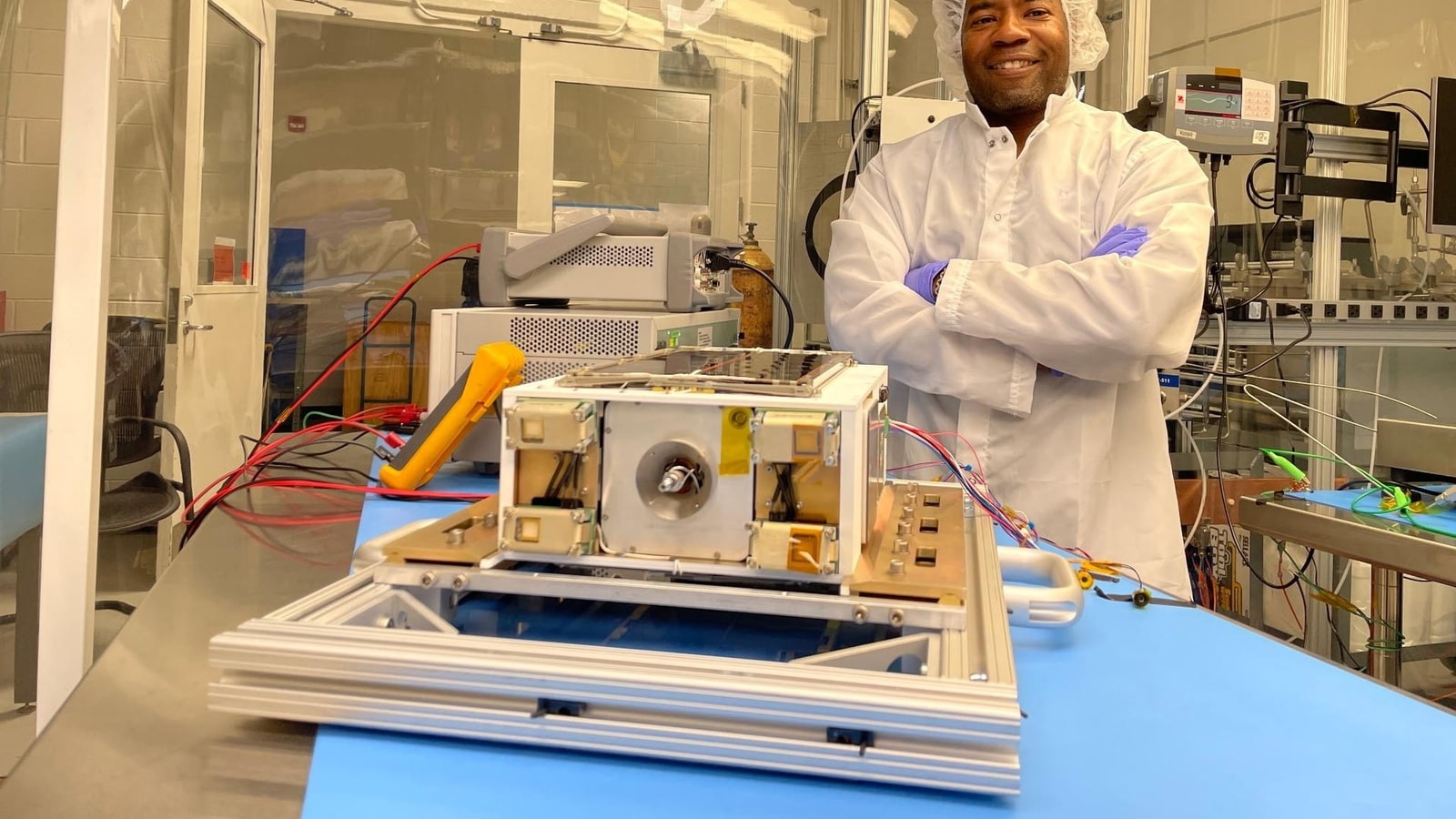
Small spacecraft live inside a brutal accounting system. Every tank, valve, heater, line and bracket occupies mass and volume that cannot be used by a camera, radio or scientific instrument. NASA's ASCENT Propulsion Dual Mode mission attacks that ledger by asking one propellant supply to do two different jobs.
The 6U CubeSat uses ASCENT, the Advanced Spacecraft Energetic Non-Toxic propellant, from one central tank. NASA says the tank will feed a high-thrust chemical engine for short, forceful maneuvers and low-thrust electrospray thrusters for efficient gradual maneuvers. Spacecraft commonly gain those capabilities from separate propulsion systems, with the duplication of tanks and plumbing that follows. The experiment is designed to find out whether the two modes can share more of the spacecraft without sacrificing the reason engineers wanted both modes in the first place.
Two engines solve different problems
High thrust and high efficiency are not synonyms. A chemical thruster can change a spacecraft's velocity quickly, which matters when a maneuver has to happen over a short interval. Electric propulsion typically accelerates propellant much more efficiently but produces much less thrust, accumulating a useful velocity change over longer burns. Carrying both gives mission designers options, but conventional architectures can make the spacecraft pay twice for storage and feed hardware.
NASA's current design uses chemical propulsion hardware built by Plasma Processes and electrospray thrusters developed by MIT, with the spacecraft bus integrated by Georgia Tech. The difficult part is not drawing two arrows from a tank on a diagram. Pressure, valves, contamination control, thermal behavior, electrical interfaces and software all have to cooperate across hardware produced by different teams.
That integration is why the recent ground campaign matters. NASA reports that the spacecraft passed pressurized helium leak testing in a vacuum chamber, thermal-vacuum testing and a spin test used to characterize mass properties and balance. Those tests establish specific things: seals held under the test conditions, hardware endured simulated thermal-vacuum conditions, and engineers measured the vehicle's balance. They do not establish that the dual-mode concept works through months of orbital maneuvers.
The propellant is not the new part by itself
ASCENT has history. Formerly called AF-M315E, the hydroxylammonium-nitrate-based propellant was developed as a lower-toxicity alternative to hydrazine. NASA's Green Propellant Infusion Mission flew it beginning in 2019. NASA's small-spacecraft technology survey notes advantages including reduced vapor hazard and potentially higher density-specific impulse, while also documenting costs: ionic-liquid propellants can require more catalyst preheating and higher-temperature chamber materials.
The current mission therefore is not a first proof that ASCENT can function as spacecraft propellant. The new engineering question is whether its properties can support this shared chemical-and-electrospray architecture in a compact flight system. NASA technical work on the mission describes ASCENT as useful in both chemical and electrospray propulsion, which is what makes the common-tank arrangement possible.
Calling the propellant "non-toxic" also deserves engineering rather than advertising interpretation. Lower handling hazard relative to hydrazine does not turn energetic spacecraft propellant into drinking water. The practical advantage is that ground crews may face fewer restrictions and less specialized handling infrastructure. Those changes can affect processing time and cost as well as worker exposure.
The orbit is the experiment
NASA says the spacecraft is manifested to launch no earlier than October 1 aboard a Falcon 9 from Vandenberg Space Force Base. After deployment at roughly 325 miles altitude and initial checkout, operators plan short maneuvers with both propulsion modes. If those succeed, the nine-month mission will alternate orbit raising and lowering with the chemical and electric systems.
That sequence gives the mission a useful failure ladder. Engineers can first establish that the spacecraft survived launch and can communicate. They can then verify that each propulsion mode starts and produces the expected response. Repeated maneuvers can expose valve, feed-system, thermal or contamination problems that a single firing might miss. Orbital tracking can measure whether the resulting trajectory changes agree with predictions.
The payoff, if the architecture works, is not merely a smaller propulsion box. Reducing duplicated hardware can change the mission that fits inside a CubeSat envelope. The saved volume might become payload, power storage or margin. A lighter spacecraft may fit a cheaper launch opportunity. Or a designer can spend the mass savings on more propellant and maneuverability.
None of those benefits is guaranteed by successful ground testing. The mission exists because integration risk cannot be retired completely in a vacuum chamber. The interesting result will arrive when one tank repeatedly feeds two very different ways of moving a spacecraft and the orbit confirms that the hardware behaved as designed.
ASCENT already has flight heritage; the unresolved step is the integrated dual-mode architecture. Ground qualification reduces risk but does not establish repeated chemical/electrospray operation in orbit.